Showing posts with label gluten-free cooking. Show all posts

Thursday, September 28, 2017

Indian-spiced chicken with cauliflower, potatoes and peas

Recipes: Indian-spiced chicken with cauliflower, potatoes and peas, Cucumber raita


This dish will taste to many like "curry", although a well-known Indian cookbook writer has said there is no such thing as a curry dish in India. Rather, the spicing is just what's commonly used there, differing somewhat depending on where in the vast country you are cooking and eating. Who knew?

This particular recipe is an adaptation of one from Madhur Jaffrey's 1975 book, An Invitation to Indian Cooking. Regardless of what you call it, it's delicious and relatively simple to make. We loved it for dinner recently, I think you will too.

Indian-spiced Chicken with Vegetables


  • One large or two small boneless skinless chicken breast halves
  • 2 medium potatoes, red or yellow
  • 1/2 medium cauliflower, cut into flowerettes
  • 5 tablespoons vegetable oil
  • 1/2 teaspoon ground cinnamon
  • 1/2 teaspoon ground cardamom (I keep cardamom seeds and grind them when I need them)
  • 1 bay leaf
  • 1/2 teaspoon freshly ground black pepper
  • 2 small red chilis (I use my homegrown red Fresno chilis. The result is moderately spicy.)
  • 1/2 teaspoon ground turmeric
  • 1 medium onion, roughly chopped
  • 3 cloves garlic, peeled and roughly chopped
  • 1-inch piece of fresh ginger, peeled and roughly chopped
  • 1/2 cup of tomato sauce (could be canned) or fresh tomatoes, skinned and chopped
  • 2 cups chicken broth, canned is fine
  • 1/2 teaspoon salt
  • 1 cup frozen peas
In a small saucepan, bring your whole potatoes to a boil in water to cover. Cook until they are tender, about 20 minutes. Drain and leave in pan or a colander to cool.

Place chopped onion, garlic, and ginger in a blender with 5 tablespoons water and blend to a smooth paste.

Pat chicken breasts dry and cut them into 1 1/2-inch pieces.
Heat oil in a 12-inch skillet on medium high. Add cinnamon, bay leaf, cardamom, red peppers, ground pepper, and chicken pieces. Fry chicken pieces quickly, turning them over in the spices, until they no longer look pink, about 2 minutes. Remove from the skillet and set aside in a small bowl.

Pour the paste from the blender into the skillet, averting your face in case it splatters. Add turmeric and fry, stirring, for about 3 minutes. Now add the tomato sauce and the chicken broth. Bring to a boil, cover, lower heat, and simmer gently for 15 minutes.

Cut the cooked potatoes into bite-sized pieces. Add salt, the potatoes, and the cauliflower pieces to the sauce. Stir, bring to a boil, cover, lower heat, and simmer gently for 10 minutes.

Add chicken pieces and simmer, covered, 10 more minutes. Turn chicken and vegetables a few times while they are cooking.

Meanwhile, cook the peas in water in a small saucepan for 5 minutes. Toss with 1 tablespoon butter.

To serve: Put chicken and potatoes in soup bowls and pour sauce over it. Top with a generous helping of peas. Serve with cucumber raita on the side.

Cucumber Raita


This refreshing relish can take the place of a salad. It's especially good in summer with fresh cucumbers out of your garden.

  • 1 cucumber, peeled and either grated or cut in half lengthwise and sliced very thin crosswise
  • 1 cup plain yogurt (I've used Greek yogurt as well as regular - both are good)
  • 1/2 teaspoon salt
  • A good grind of black pepper
  • 1/2 teaspoon ground cumin
  • A dash of cayenne pepper
  • 1/8 teaspoon paprika for garnish
Empty the yogurt into a serving bowl and beat it well with a fork until it is smooth and paste-like. 

Add the cucumber, salt, black pepper, cumin, and cayenne to the bowl.

Sprinkle with paprika and, if you wish, a little additional cumin. Cover and refrigerate until ready to serve - at least 30 minutes so it's nice and chilled.


Friday, October 9, 2015

Yummy fish tacos

Recipe: Fish tacos with salsa and cilantro-lime sauce

Fish tacos were a last minute decision on a day when I was going to broil fresh wild rockfish for our dinner. I just felt like something different, and what happened was a fabulous, delectable dinner. This one is a keeper!

It's easy too. There are a couple of steps, but nothing difficult. I'd suggest making the salsa (also called Pico de Gallo) and the cilantro-lime sauce first. They both benefit from sitting for 30 minutes and this will give you plenty of time to put the rest of the tacos together.

Note: I served the tacos with Brussels sprouts brown rice, which takes 40 minutes to cook and should sit for 10 minutes after it's done. If you want to add this to your dinner, start the rice before doing anything else. Here's the recipe. Otherwise, you could open a can of black beans and cook them in their juice for 10 minutes. Serve with chopped onion and avocado alongside the fish tacos.


Fish Tacos


For the Salsa

  • 2 tablespoons chopped onion
  • 1/2 teaspoon chopped hot pepper, jalapeno or red padron
  • 2 or 3 plum tomatoes, or one small regular tomato, chopped in small pieces
  • Juice from 1 fresh lime
  • 1/4 teaspoon salt
  • A grind of fresh black pepper

Mix all ingredients together in a small bowl. Let sit for 30 minutes.

For the Cilantro-Lime Sauce

  • 2 heaping tablespoons mayonnaise
  • 2 heaping tablespoons sour cream (light sour cream works fine)
  • 1 tablespoon chopped fresh cilantro
  • 1 tablespoon fresh lime juice
  • 1/2 teaspoon garlic granules (not garlic salt)
  • 1/2 teaspoon onion powder

Mix all ingredients together in a small bowl. Let sit for 30 minutes.

For the Fish
Mix together the following spices in a small bowl:

  • 1/4 teaspoon dried oregano
  • 1/4 teaspoon dried thyme
  • 1/8 teaspoon smoked paprika
  • 1/8 teaspoon cayenne pepper
  • 1/8 teaspoon ground white pepper

Cut 1 large fish fillet, or 2 small ones, into medium cubes. You can use rockfish, as I did, or snapper, or tuna, or whatever you like. Sprinkle the fish cubes with the spice mix and toss with your hands.

Heat a skillet with 1 tablespoon vegetable oil. Add the fish cubes and cook, tossing with a wooden spoon, for 1 minute. Add 1 clove garlic, chopped, 1 tablespoon good white wine, and 1 tablespoon chopped fresh cilantro. Cook, tossing, 1 minute. Turn off the heat.

Heat corn tortillas (2 or 3 per person) on a hot griddle or wrapped in damp paper towels in a microwave until they are soft (10-15 seconds in microwave). Place 2 or 3 on each plate, fill with fish and salsa and then drizzle the cilantro-lime sauce over. Serve immediately with more salsa and sauce on the side.


Monday, February 16, 2015

Havana on my mind

Recipes: Little pork tenderloin with orange marmalade, Black beans with slow-cooked onions, Plantains

 
All the recent talk about travel and improved relations with Cuba has been very exciting. Cuba is high on my list of places I'd like to visit, and it seems like it might actually be possible to go before too long. I already have books about the wonderful clubs that were once popular in Havana, and the cocktails that made them famous. I have CDs of the music of Cuba, and it seems so fun and carefree, although the music of a place can be deceptive - sometimes it is more indicative of the spirit of the people than the reality they live in. Regardless, there are many things about Cuba that interest me, and food is definitely one of those things. I suppose that goes without saying.
 
Occasionally I cook meals that might be similar to food you'd find in Havana. They are things I've had in Cuban restaurants here in the U.S., and of course that doesn't mean they are authentic. Authentic or not, a Cuba-inspired meal I made the other day was delicious - a combination of sweet-tart pork, savory black beans, and fried plantains - so I guess that's really what it's all about.
 

Black Beans with Slow-cooked Onions

 
Start these before the meat, as the onions take longer to cook.
In a medium Dutch oven or heavy pot, heat a tablespoon olive oil. Add 1 medium onion, sliced very thin, and 1/2 teaspoon sea salt. Stir well and then turn the heat down very low and cover the pot. Cook, stirring occasionally, until the onion is very soft and just beginning to brown. This may take 20 or 25 minutes. When the onion has cooked for 10 minutes or so, you can add a chopped or thinly sliced hot pepper and 3 or 4 sliced cloves of garlic. Stir a bit, then re-cover and continue stewing until onion is finished.
 
When the onion is finished, add a can of black beans including the liquid. Stir to mix well and cook, uncovered, for 15 minutes over medium low heat. Turn off the heat and hold, covered, until you are ready to serve.
 

Little Pork Tenderloin with Orange Marmalade

 
  • A 1 or 1.5 pound pork tenderloin (I usually use Trader Joes)
  • 1 tablespoon olive oil
  • Sea salt and freshly ground pepper
  • 3 tablespoons orange marmalade
 
Preheat the oven to 450 degrees F.
 
Pat the pork tenderloin dry with paper towels and salt and pepper it. In a skillet that can go into the oven, heat the oil and then brown the tenderloin on all sides over medium high heat.
 
With a tablespoon, slather the top of the tenderloin with the marmalade.
 
Put all in the preheated oven for 15 minutes, turning the roast halfway through the time.
 
Take the roast out of the oven and let it settle on a cutting board for at least 10 minutes before cutting it.
 

Fried Plantains

 
Buy a plantain that is as black as possible - the blacker it is, the sweeter it will be. A plantain that looks like it is way over-ripe (if it were a banana) is perfect. One plantain is enough for two people.
 
Peel the plantain and cut it into slices about 1/2 inch thick on the diagonal.
In a small skillet that will hold the slices in one layer, melt a tablespoon of butter. Arrange the plantain slices in the butter and saute over medium heat for about 3 minutes, until the bottom starts to brown. This happens faster than you think! Turn the slices over and brown the other side. You're done.
Cut the pork tenderloin into slices and serve with black beans and fried plantain. This dinner would be even better with a Cuba Libre! - Bacardi rum and Coke over ice with a squeeze of lime. Enjoy!


Tuesday, January 20, 2015

Still soup season: Butternut squash and ginger

Recipes: Butternut squash soup


It's January (Happy New Year to you!) and, while it's no longer raining as much as we wish it would, the evenings are cold. Soup still tastes really good, so I'm taking this opportunity to include another of my favorite winter recipes - butternut squash soup with ginger.

The story of this soup takes us halfway around the world, to Australia and back. I traveled there with my family years ago, and while staying in Manly Beach outside Sydney, I tasted a wonderful soup called Pumpkin Soup in a small local restaurant. I begged the chef to give me the recipe, which was actually made with butternut squash rather than what we would call pumpkin, and he finally did. Or so I thought. When I got home I made the recipe several times, but it never tasted quite as good as I remembered it did in Manly Beach. Something was missing. Something important. Then one day I was looking through a magazine and saw a recipe for butternut squash soup. It contained an apple. I knew right away that was what was missing - a hint of sweet, a hint of tart. I added an apple to the recipe that chef in Australia had given me and there it was. Perfection. Never give up!


Butternut Squash Soup with Ginger


Note that you must bake the squash for 1 hour before making the soup. This can be done even a day or so in advance, and then you can cover the whole squash and refrigerate it for future last-minute use.
  • 1 small to medium butternut squash, cut in half, seeded, and baked cut side down at 375 F for 1 hour. Scrape the soft flesh out from the skin with a large spoon to add it to the soup. Discard the skin.
  • 1 small onion, chopped
  • 2 cloves garlic, minced
  • 1/4 cup (4 tablespoons) butter
  • 2 tablespoons all-purpose (or gluten-free) flour
  • 3 cups chicken or vegetable broth (canned or home made)
  • 1 medium apple, peeled, cored, and chopped. I use a MacIntosh or a Pink Lady or a Granny Smith; any good-tasting sweet-tart apple will do.
  • 1/2 teaspoon dried thyme
  • 1/4 teaspoon salt
  • 1/2 cup half-and-half or heavy cream
  • freshly grated ginger root

Saute the onion and garlic in the butter in a medium soup pot. Add the flour, stirring until smooth. Cook, stirring, one minute. Add the broth and bring to a boil, stirring. Add all remaining ingredients except cream and ginger and simmer 10 minutes.

Let cool slightly, then puree in a food processor or with an immersion blender until smooth. Return to the pot if necessary, add cream and ginger, and reheat. Serve with more grated ginger, according to your taste.

This soup freezes well if you freeze it prior to adding the cream.

This soup is gluten-free if you use gluten-free flour mix instead of flour and is vegetarian if you use vegetable broth instead of chicken broth.


Thursday, September 4, 2014

Little bitty pork roast (perfect for two)

Recipe: Pork tenderloin with peas and potatoes


In general, roasts are tough to size for two people. They're just too big! A pork tenderloin, however, is often in the 1 to 1-1/2 pound range, the perfect size. Pork tenderloin is so easy and quick to cook that it is a natural for a mid-week dinner for two. Combine this succulent meat with roasted potatoes and quick-cooking peas, and you have a memorable meal.

Pork Tenderloin with Peas and Roasted Potatoes


  • A pork tenderloin, 1 to 1-1/2 pounds
  • Extra virgin olive oil
  • Sea salt and freshly ground black pepper
  • 1/4 cup pure maple syrup
  • 1/4 teaspoon cinnamon
  • A dash ground cloves
  • 1/8 teaspoon ground cayenne pepper
  • 2 medium potatoes, any color, or 4 small ones
  • 1-1/2 cups frozen green peas
  • Butter

Heat the oven to 400 degrees F. Wash and prick the potatoes and set them on the oven rack to roast for 45 minutes.

Pat the roast dry with paper towels and season with salt and pepper. Heat a tablespoon of the oil in a 12-inch skillet, and brown the roast on all sides (about 10 minutes). If the skillet is ovenproof, turn off the heat and hold the tenderloin as is until the potatoes have cooked 45 minutes. If your skillet is not ovenproof, transfer the tenderloin to a baking dish.

Combine the glaze ingredients for the roast, the maple syrup, cinnamon, cloves, and cayenne, in a small bowl.

When the potatoes have cooked 40 minutes, turn the oven heat up to 450 degrees F. Pour the glaze over the roast. When the oven hits 450, put the roast in, resetting the time for 12 minutes. Leave the potatoes in the oven, they'll continue to cook. At the halfway point (6 minutes), turn the roast over.

Meanwhile, bring a small amount of salted water to the boil in a small saucepan. Put the frozen peas in the boiling water and partially cover. Lower the heat and cook for 5 minutes. Drain the water off and add 2 tablespoons butter and a few shakes of sea salt. Recover and shake the peas to combine. Leave covered.

When the roast has cooked, take it out and place it on a cutting board. Let it rest for 10 minutes. Take the potatoes out of the oven and turn it off. When the resting time is over, slice the meat and arrange it in a serving dish with the roasted potatoes, split in half. Pour any glaze that remains in the roasting dish over the meat. Pour the peas over it all. Dig in!

This delicious dish is gluten-free.

Wednesday, August 13, 2014

Tuna noodles update (eating on Memory Lane)

Recipe: Tuna noodles with mushrooms


When I was growing up in the rural U.S. Midwest, all the moms made casseroles. In case you're not from that place or time, casseroles are one-dish meals, usually baked, and include a protein (often ground meat), a starch (usually noodles or rice), and a vegetable. In many cases the "vegetable" would not qualify as a veggie today. Canned cream of mushroom soup was considered a vegetable (mushroom pieces!), as was canned cream of celery soup. These dishes were carried to church suppers and pot-luck picnics, and delivered to friends who were sick or had suffered a death in the family. Casseroles were also served at home for a quick-to-make, sustaining meal. Many of them were delicious, and this was a matter of pride and competition among the cooks, even if they weren't always so healthy.

Tuna noodle casserole was one of my favorites. My mom also loved it - a can of cream of mushroom soup, a can of tuna, half a bag of egg noodles, and voila! It was dinner. I can't quite get myself to do the canned soup thing anymore, but I was nostalgic for tuna noodles one day several months ago and found an updated version on the internet. Here it is with a few tweaks of my own - tuna noodle casserole with home-made cream sauce and real mushrooms. It tastes just like the original, but even better.

Tuna Noodles


  • Half an onion, chopped
  • 3 tablespoons butter
  • 6 ounces mushrooms, sliced or cut in quarters
  • 2 teaspoons soy sauce
  • 3 tablespoons sherry
  • 3 tablespoons all-purpose flour (or gluten-free flour, if desired)
  • 1 cup chicken broth
  • 1/2 cup whole milk (or combo half-and-half with 2% milk)
  • 2 teaspoons fresh lemon juice
  • Sea salt
  • 1 6-ounce can tuna, drained
  • 4 ounces curly egg noodles (or brown rice-quinoa noodles, if desired)
  • 3/4 cup fresh bread crumbs (or gluten-free bread crumbs)
  • 2 ounces grated cheddar
  • 1 teaspoon olive oil
 
Preheat oven to 375 degrees F, with a rack in the middle position. Butter a 1-quart baking dish or a deep-dish pie plate.
 
In a 12-inch skillet, saute onion in 1 tablespoon butter with a pinch of salt until softened, about 5 minutes. Increase heat to moderately high and add mushrooms and saute, stirring occasionally, until mushrooms begin to give off their liquid, about 2 minutes. Add soy sauce and cook, stirring, until liquid is evaporated. Add sherry and boil, stirring, until it is evaporated. Turn off the heat and set aside.
 
Melt remaining 2 tablespoons butter in a heavy saucepan over medium low heat. Whisk in the flour, then cook roux, whisking, for 3 minutes. Add the broth in a stream, whisking, and bring it to a boil. Whisk in the milk and simmer the sauce, whisking, for 5 minutes. Stir in the mushroom mixture, lemon juice, and 1/4 teaspoon salt. Flake tuna into the sauce and stir gently. Taste and season with salt and pepper as needed.
 
Meanwhile, cook noodles in a large pot of boiling water with 1 tablespoon sea salt until barely done. Do not overcook, as the noodles will cook a bit more in the oven. In particular, if you are using gluten-free noodles, do not cook more than 6 to 7 minutes. Drain the noodles and return them to the pot. Add the sauce and stir gently to combine. Transfer the mixture to your baking dish, and spread it out evenly.
 
Toss bread crumbs and cheese together in a bowl. Drizzle with a little oil and toss again, then sprinkle it evenly over the casserole. Bake until topping is crisp and sauce is bubbling, 20 to 30 minutes.
 
Tuna noodles is wonderful served with a plate of avocados and tomatoes, dressed with olive oil and balsamic vinegar. Buon appetito!
 
You can make Tuna Noodles gluten-free by using the GF options in parenthesis.


Thursday, July 31, 2014

Quick 'n easy salmon salad

Recipes: Summer salad with salmon, Quick pickled cucumber and onion


I've been working long hours this summer bartending poolside at a local resort, and when I finally drag myself home the last thing I feel like is making dinner. What to do when you're hungry and tired, and going out doesn't sound good?

Fortunately it's also tomato season, and while I've been at work my partner Wayne has been tending the tomatoes. We are rewarded with wonderful ripe Early Girls and two different varieties of heirlooms plus fabulous Italian marzanos. And there are also three varieties of cherry/grape-style tiny tomatoes that are producing like crazy. You can see we'd be awash if we hadn't solved both the "too-tired-to-cook" and the "too-many-tomatoes" challenges by dining on salads three worknights in a row.

Our tomato-y salads were all delicious and so fresh, but the third was the best. Possibly it was so good because it was topped with chunks of broiled salmon. There are many variations of this idea - slices of sauteed chicken breast, rare New York steak, or sauteed portobello mushrooms - mmmm. Try it this summer when it's too hot or you're too tired to cook, you'll love it!

Summer Salad with Broiled Salmon 
Salmon salad


  • Fresh baby lettuces, like butter lettuce, red leaf, romaine, arugula, cut or torn if large
  • Fresh ripe tomatoes, any kind
  • Feta cheese
  • Half a can of garbanzo beans, drained
  • A few fresh basil leaves, torn
  • Extra virgin olive oil
  • Balsamic vinegar
  • Sea salt
  • Freshly ground black pepper
  • 1/2 pound piece of salmon

Prep a baking dish with melted butter and flop the salmon over a couple of times in it. Salt and pepper the side that you leave up. Turn on the broiler to high, but don't cook the salmon yet.

Wash, spin dry, and arrange the lettuces on a large plate. Slice or cut up the tomatoes and arrange them on the lettuce. Sprinkle the garbanzo beans and then the feta, crumbled, over the tomatoes and lettuce.

Slide the salmon under the broiler for 6 minutes, unless it's very thin (5 minutes if it's thin). Take the salmon out and turn off the broiler. Let it sit for a few minutes to cool off.

Meanwhile, drizzle the salad sparingly with the olive oil. Drizzle it slightly less sparingly with the balsamica. Sprinkle the torn basil over it all.

Slice the salmon or cut it into chunks with a fork. Place it on the salad and serve. Yum!

This salad, as well as the pickled cucumbers that follow, is gluten-free.


Pickled Cucumber and Onion


My neighbor brought over some of those long, sweet cucumbers in exchange for some of our tomatoes. I remembered a dish from my childhood. All summer long my mom would keep a dish of cucumbers and onions in the refrigerator. So I made some. It was really good with the salmon salad.

  • 1 cucumber, peeled and sliced
  • 1/2 red onion, sliced thin
  • Apple cider vinegar
  • 1/2 teaspoon sea salt
  • 1/4 teaspoon sugar

Put the sliced cucumbers and onions in a bowl. Add the vinegar, salt, sugar, and a splash of water to cover. Cover with cling film and let sit in the fridge while you make the salad. Serve with anything, all summer long.

Wednesday, May 28, 2014

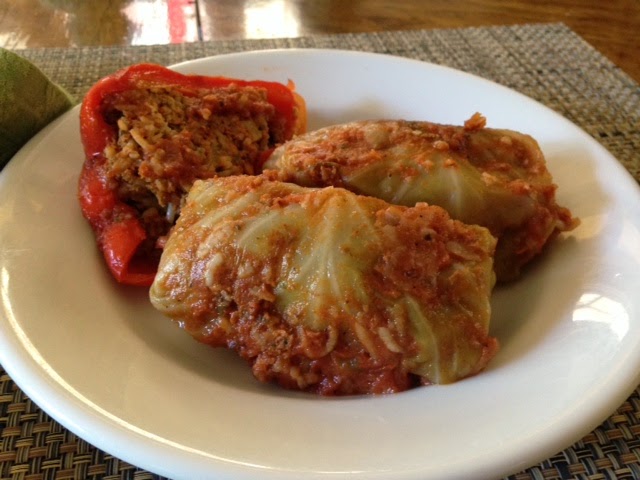
Yasmin's Stuffed Cabbage

Recipes: Stuffed cabbage rolls and other stuffed vegetables


Our friend Yasmin is staying with us for a week while she does some work in the Bay Area. Yasmin and her entire family emigrated to the U.S. from a small town near Jerusalem in Israel about ten years ago. For a few years they were our next door neighbors, although they have now moved on to Denver. We have remained good friends with the entire family, who are lovely, generous people and very warm-hearted.

Yasmin's mother was originally from Portugal and lived also in Mozambique in her young days. Yasmin's father's family was originally from Poland and then Israel. Both Yasmin and her mother are fabulous cooks, so I was really happy that she was willing to make dinner for us one night. This is one of the many delicious foods she makes at home, and I think it must have originally come from her father's Polish background, although it contains mint and other things that tie it to the Middle East.

Yasmin's family is larger than ours, so out of habit she made enough for an army rather than for just the three of us. Fortunately, stuffed cabbage rolls and other stuffed vegetables are even better after a night in the refrigerator, so we'll be enjoying them again today. I've altered the recipe so it makes two dinners for two, because you simply must taste the delicious benefit of letting the flavors meld for the second day meal.

Stuffed Cabbage Rolls and other Stuffed Vegetables


Cut a slice off the core end of a small green cabbage and discard any damaged outer leaves. Put the whole cabbage into a large pot of boiling water and boil gently over medium heat until the leaves are soft, about 20 minutes. Peel and cut the root end off a large yellow onion - it could also be a sweet onion, like a Vidalia or a Maui onion - and put it whole into the same pot to cook with the cabbage.

Meanwhile, make the stuffing.

Stuffing
Soak 1/2 cup of white basmati rice in a small bowl with hot water, and let it sit while you prepare the rest of the ingredients.

Into a large mixing bowl, put:
  • 1/2 pound ground turkey, or ground beef, or ground lamb. We used ground turkey because that's what I had, but I think ground lamb would be amazing in this dish too.
  • 1/2 medium onion, chopped
  • 2 large cloves garlic, chopped
  • A handful of parsley, chopped
  • A handful of cilantro, chopped
  • A handful of fresh mint leaves, chopped
  • 2 carrots, peeled and chopped
  • 1 stalk celery, chopped
If you have a food processor, you can process all the chopped vegetables and herbs together, then add them to the bowl with the ground meat.

Add to the ingredients in the bowl:
  • 1/2 small can tomato paste
  • 2 tablespoons sweet red paprika
  • 1 teaspoon black pepper
  • 1 teaspoon sea salt
  • 1 teaspoon cumin
  • 1 teaspoon of chicken bouillon powder
Drain the rice and also put it in the mixing bowl. Mix all the ingredients very well with your hands.

When the cabbage is soft, drain it and the onions and place them on a counter surface to cool. When the cabbage is cool enough to handle, begin to peel each leaf off until you have a pile of separate large cabbage leaves. You will probably not be able to use the small leaves near the center of the cabbage.

Cut a slit in the side of the boiled onion, right to the center but not through to the other side. Peel the layers off the onion until you have a small pile of cooked onion layers. Now you are ready to stuff.

Lay one cabbage leaf with the root end toward you and put a large spoonful of filling near the edge closest to you. Fold each side over the filling and then roll the leaf away from you until the filling is enclosed. Put the stuffed roll into a large pot that can be used on the stovetop - possibly the same pot you boiled the cabbage and onion in (that's what we did). Continue this process until you have used up the cabbage leaves. Then do the same with the onion layers, putting a spoonful of stuffing at one end and rolling it up. Lay the stuffed onions in with the stuffed cabbage rolls.

Yasmin made twice as much stuffing as we are making, so there was plenty left after stuffing the large cabbage she used and some onion. So, she also stuffed two washed, cored, and seeded red bell peppers. And she says at home she often stuffs whole zucchini, the insides scooped out with a spoon to make room for stuffing, and even potatoes, peeled and again with the inside scooped out with a spoon. It seems the possibilities might be endless!!

When you have finished stuffing the cabbage, the onions, and whatever else your little heart desires, fill the pot with water just barely to the top level of the stuffed vegetables. Turn on the heat to medium high and bring it to a boil. Meanwhile make the sauce.

Sauce
Mix together in a smaller bowl:
  • The other 1/2 can of the tomato paste
  • 1 tablespoon sweet red paprika
  • 1 teaspoon black pepper
  • 1/2 teaspoon sea salt
  • 1/2 teaspoon cumin
  • 1/2 teaspoon chicken bouillon powder
  • 1-1/2 cup water
When the water in the stuffed vegetables come to a boil, pour the sauce into the pot. Turn the heat down to medium low and cook the pot, covered, for 45 minutes. It should be simmering. After 45 minutes, uncover the pot and cook for 15 more minutes to cook the sauce down. Turn off the heat and let it sit for 15 or 20 minutes while you set the table. Buon appetito!

Saturday, May 24, 2014

Mmmm, chicken livers and bacon!

Recipe: Chicken livers with bacon and onions


I'm not going to make a big deal of this, but a lot of people don't like to eat liver. I'm one of them. My mom, bless her heart and soul, could cook the life out of a piece of calves' liver, even with fried onions. It was like dried shoe leather and, as a kid, I was required to eat at least half of whatever was on my plate. The only thing that saved me was copious amounts of Heinz 57 sauce.

Imagine my horror on a trip to the romantic Furnace Creek Inn in Death Valley years later, to find chicken livers on my breakfast plate. And let me mention that in Death Valley, there is nowhere to eat but the Furnace Creek Inn, normally a fine choice, so I was stuck. My Midwestern training still intact, I dutifully tried them. Heaven!! What a shock! So, although I still won't touch calves' liver, chicken livers are now among my favorite dishes. Go on, give it a try!

Sauteed Chicken Livers with Bacon and Onions


The trick with chicken livers is to not overcook them.

  • 1 pound chicken livers, cut in half
  • 2 slices thick bacon, cut in pieces
  • 1 tablespoon olive oil
  • 1 medium onion, cut in half and then in 1/2-inch slices
  • 1/4 cup dry white wine, like sauvignon blanc
  • sea salt and freshly ground black pepper

In a large skillet, fry the bacon pieces until they are just short of crisp. Add the olive oil and the onion and 1/2 teaspoon salt. Fry, stirring now and then, until the onion is partially cooked but still holds its shape. Add the chicken livers and cook, stirring frequently, for about 2 minutes.

Pour in the wine and turn up the heat a little. Cook for another two minutes until the wine is almost gone. Turn the heat off.

Add salt and a generous grind of pepper and toss gently to combine. Serve alone with a green salad, or over cooked pappardelle (wide egg pasta) or spaghetti, or over baked or steamed potatoes.

The payoff:
Chicken livers give you a good dose of iron and protein plus vitamins B12 (terrific for stress) and A (sharp eyes).
This dish is gluten-free, served alone, over gluten-free pasta, or with potatoes.
 

Thursday, May 15, 2014

Five ways to eat more broccoli (be good to your body!)

Recipes: Broccoli stir-fry, Long-cooked broccoli, Chopped broccoli, Wiki-wiki salad, Broccoli potato soup


Fresh green broccoli is so good and good for you, and late winter plus spring-into-summer is the time when you'll find it in farmer's markets. But cooking and eating it in some new way that'll wake up your taste buds can be challenging.

Tired of steamed spears with butter and lemon? Good as that is, sometimes we all need something new.

Here are a few pretty sweet suggestions for that great bunch of broccoli you have in the fridge.


1. Broccoli Stir-fry


  • 1 pound fresh broccoli
  • 2 tablespoons peanut oil
  • 1 teaspoon sea salt
  • 1 teaspoon sugar
  • 1 tablespoon water
  • 1 teaspoon cornstarch combined with 2 tablespoons cold water

Start by cutting the ends off the broccoli stalks and cutting the florets. Then peel the tough skin off the big stems with a vegetable peeler or paring knife. Cut florets and peeled stems into 1-inch pieces.

Mix the cornstarch and cold water well in a small bowl and set aside.

Heat a wok or large skillet until hot. Add the peanut oil and stir-fry the broccoli pieces for about 2 minutes. Add salt and sugar and mix well. Add the tablespoon water and cover the wok or skillet. Let cook over high heat for a minute or so, stirring once. Uncover the pan.

Add the cornstarch-water mixture and cook over high heat for 1 minute. Serve hot over rice or noodles, or over sliced cooked chicken. Season with Tamari soy sauce and a drop of sesame or chile oil if you wish

Asparagus, zucchini, or cauliflower can be combined with broccoli or used instead of broccoli using the same stir-fry method, except that no peeling is required for those vegetables.

2, Long-cooked Broccoli

Adapted from a recipe in Alice Waters' Chez Panisse Vegetables
  • 1 pound broccoli
  • 4 cloves garlic
  • 1-1/4 cups water
  • 1/4 cup olive oil
  • 1/4 teaspoon red pepper flakes
  • Salt and pepper
  • 3 flat anchovy fillets
  • 1/2 fresh lemon
  • freshly grated Parmesan
Pick off any leaves and peel the tough skin off the broccoli stems with a vegetable peeler or paring knife. Slice the broccoli stems and florets crosswise into 1/8-inch-thick slices. Put the slices into a skillet or shallow saucepan 2 to 3 inches deep. Peel and slice the garlic and add to the pan with the water, olive oil, and red pepper flakes. Season with salt and pepper.

Bring to a boil, cover, and simmer for 50 minutes, until the broccoli is tender and starting to fall apart, and the liquid is nearly evaporated. If the pot goes dry before the broccoli is done, add a little more water.

Roughly chop the anchovies. When the broccoli is done, sprinkle the anchovies over it, squeeze the lemon over it, and toss everything together. Serve on a warm platter and garnish at the table with a grating of Parmesan.

3. Chopped Broccoli with Lemon

From Deborah Madison's Vegetarian Cooking for Everyone

Something as simple as chopping the broccoli instead of leaving it large changes it completely.
  • 1 pound broccoli
  • 2 tablespoons extra virgin olive oil or butter
  • Sea salt and freshly ground pepper
  • Fresh lemon for juice

Chop the broccoli into small florets and peel and finely chop the stems. Put the stems in the steaming basket, add the florets, then cover and steam until just short of tender. Put in a serving bowl, toss with olive oil or butter and season with salt, pepper, and lemon juice.

For a heartier dish, toss equal amounts of boiled diced potatoes, cooked rice, or cooked quinoa with the cooked chopped broccoli.

4. Wiki-wiki Salad


This salad was posted earlier in this blog, but it's definitely worth repeating. Who knows where the name came from? It's basically a broccoli-cabbage-snow peas cole slaw, and can be a whole meal on a hot day.

  • 1/2 small green cabbage, cored and sliced thin as for cole slaw
  • a good handful of snow peas, ends removed, and sliced into bite-sized pieces
  • 4 scallions (green onions), diced including white and green parts
  • 1/4 pound broccoli flowerettes, cut fairly small
  • 1/2 cup slivered almonds, toasted on top of stove or in oven
  • 1 pack Top Ramen noodles, chicken flavor
 Dressing:
  • 1 flavor pack from Top Ramen noodles - chicken flavor
  • 1 tablespoon sugar
  • scant 1/2 cup vegetable oil (like Wesson)
  • 3 tablespoons red wine vinegar
  • 1 teaspoon garlic salt (or 3/4 teaspoon sea salt and 1/4 teaspoon garlic powder)
  • 1/2 teaspoon freshly ground black pepper
Combine cabbage, snow peas, scallions, broccoli, and almonds in a large bowl. Crunch the ramen noodles and add them. Mix together dressing ingredients in a small jar with a cap. Shake well. Add dressing to the cabbage mixture and toss thoroughly. Wiki-wiki is best if it sits for 30 minutes or so before you serve it.

5. Broccoli Potato Soup


Adapted from a recipe in Marcella Cucina
  • 1/2 large yellow onion, sliced very thin
  • Sea salt
  • 1/4 cup extra virgin olive oil
  • 2 tablespoons butter (divided use)
  • 3/4 pound broccoli florets, washed and cut into 1-inch pieces
  • 1 garlic clove, peeled and sliced crosswise very thin
  • 2 medium red potatoes, washed and cut into medium dice
  • 1 1/2 cups chicken broth
  • Freshly ground black pepper
  • 3 or 4 fresh basil leaves, torn (optional)
  • 1/2 cup freshly grated Parmegiano-Reggiano cheese
Put the sliced onion, a pinch of salt, all the the olive oil, and 1 tablespoon of butter in a heavy saucepan or Dutch oven. Turn on the heat to medium low and cover the pan. Cook, stirring occasionally, until the onion is completely tender and has become colored a light brown.

When the onion is cooked, add the sliced garlic and leave the pan uncovered. Cook, stirring for 1 minute. Add the broccoli florets and a generous pinch of salt, and cook, turning the florets over now and then, until they feel tender when you prick them with the tip of a paring knife.

Add the diced potatoes and cook for about 5 minutes, turning the contents of the pan over frequently. Add the broth and cook until some of the potatoes dissolve as you stir them (20 minutes or so). The final consistency should be loosely creamy, rather than real thick.

Taste and correct for salt, and add liberal grindings of black pepper. If you are holding to heat later, put the pot aside. When you are ready to serve the soup, swirl in the torn basil (if using), the grated Parmesan, and the remaining tablespoon of butter. Serve at once in bowls.

Friday, May 9, 2014

Warm summer night salad bowl

Recipes: Chef's salad, Thousand island dressing, Vinaigrette


May. That time of year when one day it's summer and the next day it's not. When it's summer and hot, the last thing you want to do is heat up the stove and work hard over dinner. That's when it's time to go for the salad bowl - crisp lettuces, a little protein, some veggies, maybe a few crumbles of cheese. And, definitely, home made dressing. If you haven't tried making your own salad dressings, you're in for a big treat! I promise, you'll never go back to supermarket dressings again.

Salad Dressings 101: Thousand Island


This is my BF's favorite dressing. He's been known to order Caesar Salad with Thousand Island on the side. Serious. The bad thing is, even the best supermarket Thousand Island tastes like chemicals, because that's the only way it doesn't spoil on the shelf. The good thing is, it's easy to make at home, so why wouldn't you? I make just enough for two with a big dinner salad. If there's any left over we have it for lunch the next day. Thousand Island lasts in the fridge no more than three days, so don't make a double batch unless you're feeding a crowd.

In case you're curious, Thousand Island dressing was named for the thousand islands in the St. Lawrence River between Canada and the northern border of the U.S. Legend has it that it was invented in that region and popularized at the Waldorf Astoria Hotel in New York. It was wildly popular by the 1950s.

  • 1/4 cup chopped sweet pickles. Bread and butter pickles work well for this (Trader Joe's, most supermarkets) or regular sweet pickles or gherkins. Don't use sweet pickle relish, which will give the dressing a bad taste.
  • 2 chopped green olives with pimientos, or 6 chopped pickled jalapeno slices (the favorite at our house)
  • 1/2 cup mayonnaise
  • 1/4 cup ketchup
  • 1/2 tablespoon chili powder (generic, or I use New Mexico Red Chili powder)
  • 1 clove garlic, chopped fine
  • 1 teaspoon water
  • Juice of half a fresh lemon
  • 1/2 teaspoon sea salt
  • 1/4 teaspoon black pepper

Mix all together in a bowl. Cover with cling film and refrigerate while you are making your salad. If you can let the flavors meld for an hour, that's great. If not, it'll still be fabulous.

Thousand Island dressing is also wonderful on burgers, or in Reuben sandwiches. Yum!

Salad Dressings 102: Vinaigrette


This is my favorite, and there are at least a million ways to make it. Unlike Thousand Island and other mayonnaise-based dressings, vinaigrette lasts a week or more in the refrigerator. I make a little jar of it and keep it on hand. When I want to use it, I take it out of the fridge so it can come to room temperature, then I shake it up good. Never can tell when you might want an avocado or some raw cauliflower with a drizzle of vinaigrette!

  • In a small jar with a cover, add 1/2 teaspoon mustard powder, 1/2 teaspoon sea salt, 1/2 teaspoon sugar, 1/2 teaspoon herbes d'Provence (or other dried herb you like), 1 tablespoon unflavored rice vinegar, and one tablespoon fresh lemon juice. Put the cover on, and shake well.
  • Add 5 tablespoons good extra virgin olive oil. Put the cover back on and shake well again. Keep in refrigerator and bring to room temperature before shaking and using.

Use vinaigrette sparingly on your salad, and toss well to distribute it.

There are other good salad dressings you can make at home. One of them is Blue Cheese Dressing, which we've already covered in this post. Blue Cheese dressing is another one where the supermarket version falls far short of home made. If you've tried the supermarket dressing and didn't like it, try the home made. You might find true love.

Chef's Salad


Chef's Salad is a name for a salad that has in it whatever the Chef wants to put in it. That's you!! There are a few traditional items that you'll get if you order a chef salad in a restaurant, but you don't even have to pay attention to those if you don't want to.

Just for the record, the traditional items are:
  • Lettuce, often iceberg or chopped romaine
  • Julienned ham and/or turkey
  • Some kind of cheese, usually cut in sticks
  • Bell pepper strips
  • Avocado chunks
  • Tomato wedges (in or out of season, argh!)
  • Hard-boiled eggs, cut in wedges
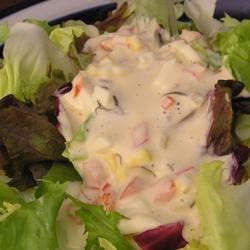
Here's the Chef's Salad I served the other night with my home made Thousand Island dressing. In this case, I made individual salads rather than one big one, just because. In our salads we had:
  • Chopped romaine lettuce
  • Sliced green onions
  • Crumbles of Maytag blue cheese
  • Roasted red bell pepper our neighbor made and shared
  • Raw cauliflower from our garden
  • Marinated and pan-grilled chicken breast (marinated in olive oil and lemon juice for 30 minutes, salted and peppered, pan-grilled for 5 minutes each side over med-high heat, let sit for 10 minutes to finish, and sliced thin)
You see, you can vary your Chef's Salad any way you, the Chef, desire. Buon appetito, and stay cool!

Thursday, May 1, 2014

Deep greens pizza (or it's all good)

Recipe: White pizza with stir-fried deep greens


My garden is overflowing with kale and chard, and everyone knows how yummy and nutritious that is. But we felt like pizza, so we came up with an interesting combination.

Preheat the oven to 400 degrees.

Take a pizza crust. You can get pizza dough at Trader Joe's, or you can buy a Boboli crust, or you can make your own, or you can even use the bottom half of a round of bread, sliced off the loaf about a half inch thick.

Tip: If you're using store-bought pizza dough, you may find it hard to roll out, or stretch out into a pizza shape, at first. Start it and then let it rest for about 20 minutes. It'll shape up.

Top your pizza crust with fresh ricotta cheese, smeared on with the back of a spoon, fresh mozzarella cheese cut in rough slices, and grated Parmagiana-Reggiano. I also strewed pitted Kalamata olives over the cheese, to give it a little kick, and sprinkled it all with a few hot pepper flakes. You could do this or not - your choice.

Put the pizza in the oven, on a pizza stone if it's dough, directly on the oven rack if it's a crust that's already baked. Bake for 20 minutes for fresh dough, or 10 minutes for prebaked crust, or until the cheese is well melted and the crust is crisp and lightly browned.

Meanwhile, make the greens.
  • 2 slices bacon (eliminate for a vegetarian version, and add 1 more tablespoon olive oil)
  • 1 tablespoon olive oil
  • A leek, well washed, with white and green part sliced
  • 3 garlic cloves, peeled and cut in half
  • 1 bunch kale, stripped from stems, washed, and sliced into ribbons
  • 1 bunch chard, stripped from stems, washed, and sliced into ribbons
  • Sea salt
  • Half a lemon

In a large wok or a large skillet, fry the bacon. Then take it out and hold it on paper towels, but leave the bacon grease in the pan. Add the oil to the grease, and heat it.

Add the leek and the garlic and stir fry over medium high heat for a minute or two. Add a large bunch of the kale/chard and keep adding more as it cooks down until you have it all in the pan. Stir often, turning over the greens so they all get a chance to cook on the bottom.

When the greens are wilted and tender (taste them!), turn the heat off, add salt to taste, add the cooked bacon, and toss well. Squeeze the juice of the half lemon over the greens and toss again.

When the pizza comes out of the oven, put it on a cutting board and cut it into slices. Put the slices on a big serving platter, or just use the cutting board as a serving platter.Top the pizza with the warm greens and carry it to the table. Pour the wine or the beer.

Buon appetito! Delicioso!

The payoff
Kale and chard are good for almost everything the body needs to be healthy...antioxidant, anti-inflammatory, support for the body's detoxification system, risk-lowering benefits for various common cancers, eye health. This stuff is all good and we should eat it as often as we can.

Deep greens pizza is vegetarian if you eliminate the bacon (use an extra tablespoon of olive oil instead) and it is gluten-free if you use a prebaked GF crust. In the SF Bay Area you can buy GF crusts prebaked at Mariposa Bakery, or you can order from them by mail.

Wednesday, April 23, 2014

Grilled chicken salad (or summer's here and we feel spicy)

Recipe: Grilled chicken salad with rustic guacamole and a roasted sweet potato


The weather's warming up and summer's here, at least for the moment here in northern California. Yay! When friends came over for an afternoon pre-concert dinner a few days ago (Willie Nelson at the UC's Greek Theatre, no less), I wanted to make something different - summery and maybe a little spicy. I went immediately to Rick Bayless' excellent cookbook, Mexican Everyday, and once more, Rick came to the rescue with a main-dish salad that zings with the tastes of Mexico..

This salad has no real precedent in traditional Mexican cooking, Rick says; nevertheless it takes the flavors and traditional ingredients and produces a deliciously rich and flavorful meal, with a little spice thrown in for fun. Healthy too! My family and guests really loved it, including one who had gluten and dairy dietary restrictions. As a matter of fact, she asked me for the recipe - a huge compliment in my book.

You can fire up the grill for this, but you don't need to. A stovetop grill pan, which is what I used, works just fine. This recipe serves 2. I just doubled it to serve 4.

Grilled Chicken Salad with Rustic Guacamole, Romaine, and a Roasted Sweet Potato

Adapted from a recipe in Rick Bayless' Mexican Everyday

Sweet potato sounded good to me, so I added it to the menu. Wash one large orange-fleshed sweet potato, or 2 small ones, and stab it with the tip of a paring knife in several places so it won't explode in the oven. Talk about excitement you don't need! Then put it or them into a baking dish and bake at 400 degrees for 1 hour (45 minutes if using small potatoes). While the potato is baking, make the salad.

For the dressing
  • 1/4 cup olive oil, plus a little extra for grilling the onion
  • 2 garlic cloves, peeled and halved
  • 1/2 jalapeno (or more if you want it quite spicy), seeded and halved
  • 1/4 cup fresh lime juice
  • 1/2 cup roughly chopped cilantro or flat-leaf parsley
  • freshly ground black pepper
  • sea salt
Heat the oil in a small skillet, add the garlic and chiles and cook, stirring frequently, until the garlic is soft and lightly browned, 2 minutes. Pour the oil, garlic, and chile into a blender or food processor. Add the lime juice, cilantro, black pepper, and 1/2 teaspoon salt. Process until smooth.

  • 2 boneless, skinless chicken breast halves
  • 1 small white onion, cut into 1/2 inch slices
  • 1 ripe avocado
  • 1 medium romaine heart, sliced crosswise into 1/2-inch-wide ribbons
  • 1/4 cup grated Mexican queso anejo or Parmesan cheese (optional)
Put the chicken breasts in a bowl and pour one-third of the garlic dressing over them, spreading it evenly over both sides.

Make the guacamole
Heat the grill or grill pan over medium high heat until it is quite hot. Lightly brush the onion slices with oil and sprinkle them with salt. Lay the onion on the grill or grill pan and turn the slices over a couple of times, grilling until they are well browned, about 3 minutes each side. Take the onion off the grill and chop it roughly. Put the onion in a bowl. Pit the avocados and scoop the flesh in with the grilled onion. Add another one-third of the garlic dressing and coarsely mash everything together with a potato masher or a large fork. Taste and season with salt, about  1/4 teaspoon.

Grill the chicken
Now heat the grill or grill pan up again and put the chicken breasts on. Cook about 4 minutes on each side, until well seared. If the chicken breasts are exceptionally thick or thin, adjust the cooking time accordingly - 5 minutes each side for thick, 3 minutes each side for thin. Take the chicken off the heat and let it sit on a chopping block for 10 minutes to finish. Then cut each breast into cubes.

Assemble the salad
Put the sliced romaine into a large bowl. Drizzle the remaining garlic dressing over it and toss well. Divide the lettuce between two dinner plates. Scoop half of the guacamole into the center of the lettuce. Arrange the cubed chicken over the guacamole. Sprinkle the whole thing with grated cheese, if you wish, or serve it separately for individual use.

Cut the roasted sweet potato in half on the crosswise diagonal, just for show, and arrange it on the plate alongside the salad. It will be beautiful! Enjoy!

The payoff
In addition to great taste, this dish has the benefit of being gluten-free and dairy-free (if you don't use the optional cheese).

Avocado, which is native to Mexico and Central America, has more potassium than bananas and lots of fiber. High avocado intake has been shown to lower blood cholesterol levels. All good. And yummy.


Wednesday, March 26, 2014

Cheeky and leeky (or hot fish and heavenly veggies)

Recipes: Broiled rockfish with Paul's spice, Braised leeks, Roasted reds


Remember when we talked about Paul Prudhomme and his spicy, delicious, and not-always-so-healthy food? There's a spice mix  that's used in his Cajun Chicken and Dumplings, an amazing dish that's rich enough to add pounds and contribute to clogged arteries. Nevertheless, I love this spice mix and keep a jar of it made up in my kitchen to use on chicken, pork, and  fish. It's fabulous on just about any kind of fish.

Here's the spice mix:

Paul's Spice
  • 1 tablespoon sea salt
  • 1 1/2 teaspoons sweet paprika
  • 1 teaspoon white pepper
  • 1 teaspoon onion powder
  • 1 teaspoon garlic powder (not garlic salt)
  • 1/2 teaspoon cayenne pepper
  • 1 teaspoon dried basil
  • 1/2 teaspoon black pepper
  • 1/2 teaspoon dried thyme
  • 1/2 teaspoon file powder (optional)

Mix all together in a small bowl. Store in a covered jar. Makes about 1/2 cup.

Here's an easy dinner for two I made recently. Wayne loved it, and he's sure glad I'm back on my feet. Yes, I'm back on my feet, and back in the kitchen cooking! I'm still in a cast, but it's a walking cast so things are definitely looking up.

Roasted Reds


Start the potatoes first, as they take the longest (about 50 minutes total). Turn the oven on to 400 degrees to heat. Then wash 6 small red potatoes and cut them in half. Put them in a small saucepan with about an inch of water and bring the water to a boil. Cover and cook for 3 minutes.

Drain the potatoes and put them in a bowl with 1 tablespoon olive oil, 1 teaspoon sea salt, and a dash of cayenne pepper. Mix them up carefully with a large spoon to distribute the oil and spices, then spread them out on a small cookie sheet or roasting pan in one layer. Put them in the oven for 40 minutes, stirring them a bit and turning the heat down to 350 degrees after 30 minutes.
 

Braised Leeks

 
I don't usually think of serving leeks, and I don't know why not. These are absolutely delicious - tender and sweet. I know you'll love them as much as I do.
  • 4 large leeks, about 1 1/2 inch in diameter
  • 3/4 cup chicken broth
  • 3 tablespoons butter
  • Salt and pepper
Cut off the roots of the leeks and strip off any withered leaves. Line them all up and cut off enough of the dark green ends to make them 6 inches long. Then cut each leek in half lengthwise and carefully wash them under running water, paying special attention to the green parts. Sand often hides in leeks, so be sure you wash them well.
Lay the leeks in an ovenproof skillet that will fit the leeks laid flat in one or two layers. Pour the broth over and dot with the butter cut in pieces. Bring the stock to a boil over medium heat, reduce the heat and boil gently for 15 minutes.
Transfer the leeks and juices, in the same skillet or in another baking dish if your skillet isn't ovenproof, to the 350 degree oven. Cover loosely with aluminum foil and bake for 20 minutes or until much of the broth has cooked away. Salt and pepper to taste before serving.
 
When the potatoes and leeks are cooked, take them out of the oven and let them cool a bit for the few minutes it takes to cook the fish.
 

Rockfish with Paul's Spice

 
I used rockfish, or rock cod, because it's a species that's native to the U.S. West Coast, where I live, and I particularly like to cook and eat wild local fish. You can use whatever fish you like, that's available where you live. Two medium filets are perfect for two people.
 
Turn your stove's broiler on to High.
 
Rockfish ready to broil
Melt a tablespoon of butter in a broiler-proof pan that will hold the fish in one layer. When the butter is melted, flop the pieces of fish over a few times in it, so butter gets on both sides. Then get out your jar of Paul's Spice and shake it. Distribute a teaspoon-full of the spice evenly over each piece of fish, just on the side that's up.

Slide the fish under the broiler and broil it on the up side (no turning) for 4 to 6 minutes, depending on the thickness of the pieces. Thin pieces get 4 minutes, pieces that are about 3/4 of an inch thick get 6 minutes. The only bad thing you can do to fish is overcook it, so err on the side of cooking it a bit less.
 
Take the fish out, turn off the boiler and you're done. Plate the fish, leeks, and potatoes with a wedge of fresh lemon and dig in. Buon appetito!

The payoff

This entire meal is gluten-free.

Leeks contain flavonoids and folates that decrease the risk of hypertension and protect your heart and blood vessels. Leeks also contain strong antioxidants that fight free radicals in your body and decrease inflammation. All good stuff!

Rockfish are lean, nutrient-dense sources of protein.


Wednesday, March 19, 2014

Emergency conditions (or your partner can make dinner too)

Recipes: Pork chops, Pasta with peas and cheese, Turkey burgers, Microwave- steamed vegetables


Life can sure throw some surprises your way! There I was, running around, shopping, cooking, working, living life, when suddenly I fell and broke my ankle and it all stopped. Then, instead of doing all those things, I found myself lying on the sofa with a heavy cast on my leg, "toes above my nose" to prevent swelling, with orders not to put any weight on my foot for two weeks. It was obvious I wasn't going to be working as a bartender for awhile, and I accepted that, but we still had to eat. Who was going to shop for food? Who was going to cook?

Fortunately there are two people living in my home, and the lot fell to my partner Wayne, who hates to shop and doesn't cook, although he's an enthusiastic eater. Turns out he has talent he didn't know he had. Here are two of the easy-to-make and wonderfully healthy meals he cooked for us under Emergency Conditions. He truly helped my ankle heal!

Pork Chops and Pasta with Peas and Cheese


Friends came to the rescue, too, especially when it came to shopping. I never realized how much W actually dislikes grocery shopping, which I love. Good thing I do. Anyway, a girlfriend and two of our wonderful neighbors did shopping for us on several occasions. That's where the fresh gluten-free pasta in this photo came from. W doesn't eat gluten. although I do, so we could both eat this. It was delicious, just like regular "glutenous" pasta.

Of course I keep meats and some vegetables like peas and corn in the freezer, so we had choices.

The pork chops
Easy as pie. Why do people say that? Pie isn't always easy. Wayne put the chops in the microwave on defrost for 5 minutes, as they were frozen. Then he heated up the cast iron skillet with a little olive oil in it, salted and peppered the chops, and cooked them, 5 minutes on one side and 4 minutes on the other.  He let them sit off the heat to rearrange juices and finish cooking while he made the pasta.

I told him the timing for cooking, but otherwise he was on his own.

The pasta with peas and cheese
Wayne does love him some peas. Almost always, he'll have peas if given a choice. He put frozen peas in a microwave proof dish with 2 or 3 tablespoons water. He micro'd it for 2 minutes, until they were heated through, not frozen and not mushy. Then he cooked the pasta.

He had fresh gluten-free fettucine, and the package said it needed to cook about 45 seconds. Yikes, that's like "in and out"! So, big pot of water boiling. W put a tablespoon of sea salt in and put a colander in the sink. Then he put the pasta in the water and stirred it. At one minute, he brought the pot over to the colander and drained it, and the pasta was perfect. Forty-five seconds might not have been enough.

He poured the pasta back into the pot, added the drained peas, and sprinkled a good handful of shredded Parmigiana-Reggiano over all. One more stir and dinner was ready. So good!

Turkey Burgers with Microwave-Steamed Veggies


Wayne made turkey burgers much the same way he made the pork chops, except that the ground turkey wasn't frozen. Our friend Jackie had just done some shopping for us and had brought it.

The burgers
Shape a pound of ground turkey (dark meat is tastiest, I think) into four or five patties, about an inch thick. Salt and pepper them on one side.

Heat a cast iron skillet, or another frying pan, with a tablespoon of olive oil or coconut oil. Add the burgers to the pan, seasoned side down, and fry for 4 minutes. Salt and pepper the up side, then flip the burgers and fry them 4 more minutes. Turn off the heat, remove the burgers to a plate, and let them stand to finish cooking while you make the vegetables.

The veggies
Wayne peeled 2 carrots and cut them into chunks. He scrubbed 6 small red potatoes and pricked them a few times with the tip of a paring knife. He cut the tops off several moderately hot little peppers (padrones) that we grew in our front yard. Then he put the carrots and potatoes in a microwave-safe bowl with a few tablespoons of water. He microwaved them on high for two minutes, then stirred them and microwaved them on high for two more minutes. He added the peppers and stirred again and microwaved them for two more minutes. He tested the potatoes and carrots, and decided to go for two minutes more.

With the addition of light sour cream on the potatoes and a little salt to taste, dinner was ready. Wasn't it beautiful? It tasted as good as it looks!

Just goes to show, dinner doesn't have to be a big production and cooking isn't brain surgery. It's enough to use colorful fresh ingredients and cook them simply with the addition of a bit of love! This was delicious home food, and I know all the veggie and protein nutrition, plus all the caring involved, helped me feel better. Wayne says he has enjoyed doing it. Maybe I can convince him to take over the kitchen once in awhile after I'm up and around again, now that we know!

Buon appetito!

Wednesday, March 12, 2014

Eating Mediterranean, with Cajun spices

Recipes: Poorman's jambalaya, Corn muffins


Sometimes you hear people talk about a "Mediterranean diet", and how healthy it is. What is that anyway? First of all, it reflects a lifestyle practiced around the Mediterranean Sea, in areas of France, Italy, Spain, Greece, Turkey, and the countries of northern Africa, that represent some of the oldest places humans have historically made their homes.  The "diet", which just means a way of eating, involves primarily plant-based foods, such as fruits, vegetables, whole grains, beans, and nuts, and a minimum of red meat. Fish and poultry, and especially fish, is eaten much more than red meat. Olive oil is used in place of butter, and herbs and spices, rather than salt, are used to flavor foods. Wine, and in particular red wine, is considered food, and accompanies meals in moderation. Meals are enjoyed with family and friends, and walking or riding bicycles is much more common than jumping in the car to go to the store, or to work. People are rarely overweight or bothered by the common diseases of abundance - high blood pressure, diabetes, cancer.

Sounds good, doesn't it? How can we shift our diet to be more like this? Here are five tips you can use to move your meals in this direction:
 

  • Make sure each meal and snack includes colorful vegetables or fruit, raw or cooked
  • Mix up your dinner routine by adding legumes like beans, peas or lentils at least some of the time
  • Cook fish instead of red meat at least two nights a week
  • Add walnuts, pecans, or sliced almonds to a salad or steamed vegetables
  • Use extra virgin olive oil in place of butter or other oils for low-heat cooking and salads
Easy enough, but what does this have to do with Cajun cooking? We're making jambalaya today. Yum! The answer is "not much", except that Cajun food, which is French Acadian in origin, has Mediterranean roots. Not to mention that it's so delicious, it's worth a little digging to find those healthy roots and bring them out.
 
<script charset="utf-8" type="text/javascript">Paul Prudhomme's Louisiana Kitchen, the bible of Cajun cooking, is one of the great cookbooks, with caveats. There's hardly a recipe in it that doesn't need to be altered in some way for either health or hotness reasons. One recipe starts with "One pound, plus 4 tablespoons, butter". Most of the dishes are so spicy I can't eat them, and I like hot. For these reasons, I've hesitated to recommend it to readers. On the other hand, every recipe I've ever made from this book has been absolutely delicious, once I've tamed the heat. Chef Paul's spice combinations are incredible, and each dish is "rounded" in taste in a way that is very satisfying. It truly is amazing comfort food.  

Poorman's Jambalaya


This recipe comes from Louisiana Kitchen, with quite a bit of alteration in the seasoning mix and a few changes in ingredients and cooking time. I'm guessing this is called Poorman's because it doesn't have a lot of meat and fish in it - "only" shrimps and sausages.You will love it, poor or not.

Seasoning Mix
  • 2 small bay leaves
  • 1/4 teaspoon salt
  • 1/2 teaspoon dry mustard
  • a pinch of cayenne pepper
  • 1/4 teaspoon ground cumin
  • 1/4 teaspoon freshly ground black pepper
  • 1/4 teaspoon dried thyme
Ingredients
  • 2 tablespoons butter and 1 tablespoon olive oil
  • 6 ounces good chicken or pork sausage, uncooked, partially frozen (to make cutting easier) and sliced or diced
  • 3/4 cup chopped onions
  • 3/4 cup chopped celery
  • 1 red or orange or yellow bell pepper, cored, seeded, and chopped
  • 4 cloves garlic, minced
  • 1 cup raw basmati or jasmine rice
  • 2 cups chicken broth
  • 1 dozen medium shrimp, tails on if you wish
Thoroughly combine the seasoning mix ingredients in a small bowl and set aside.

In a large heavy skillet, or a medium heavy Dutch oven, melt the butter and heat the olive oil. Add the sausage and cook a few minutes, stirring occasionally.

Add the onions, celery, bell pepper, seasoning mix, and garlic, mixing well. Cook until the vegetables are browned, 10 to 12 minutes, stirring occasionally and scraping the pan bottom well.

Stir in the rice and cook 5 minutes more, stirring and scraping. Add the broth, stirring. Bring the mixture to a boil, reduce heat, and simmer uncovered until the rice is tender, about 30 minutes. Stir occasionally toward the end of cooking time. Add the shrimps to the rice, cover, and cook for 1 more minute.

Remove bay leaves, and serve immediately.

Corn Muffins 


You don't really need corn muffins with the jambalaya - it's a complete meal in itself - but the muffins are certainly good with it. This is provided just in case your meal wouldn't be complete without bread. They are a little sweet, but not too much.


  • 1 1/3 cups all-purpose flour
  • 2/3 cup cornmeal
  • 1/3 cup sugar
  • 5 tsp baking powder
  • 1/2 tsp salt
  • 1 cup milk
  • 4 1/2 Tbsp butter, melted
  • 1 egg, beaten

Turn the oven on to 350 to preheat.

In a large bowl combine the flour, cornmeal, sugar, baking powder and salt. Mix well with a fork. In a separate bowl, combine the milk, melted butter and egg - beat the egg into the milk/butter and add to the dry ingredients. Blend just until mixed...do not overbeat.

Spoon mixture into greased muffin cups - this recipe makes 9 muffins in my cast iron muffin pan (they are medium-large size). Bake at 350 about 45 minutes. If you use a smaller muffin pan, adjust the baking time and bake until golden brown.

When the muffins are done, remove them from the oven and take them out of the muffin pan right away.

The muffins freeze well, and are delicious for breakfast, warmed and served with honey.

The Payoff
The jambalaya is gluten-free. The muffins are not.

Jambalaya meets the criteria of the Mediterranean diet in several ways - it includes colorful vegetables (onion, celery, bell pepper, garlic), it includes fish (shrimp) and a minimum of meat, olive oil is substituted for some of the butter in the original recipe (you could substitute olive oil for all of the butter if you wish), spices and herbs are used to flavor it, and it is delicious with red wine.

Buon appetito!